Anxiety can be confusing because it doesn't always feel like a thought problem. Sometimes it feels like a physical emergency: your heart races, your muscles tighten, your stomach turns, your breathing changes, and your mind starts searching for an escape.
So you avoid whatever seems to trigger those feelings.
You don't attend the social event. You postpone the appointment. You stop driving on the highway. You avoid crowded places. You stay home because you're worried about having a panic attack.
And for a few minutes, you feel better.
That temporary relief is exactly what can make the anxiety–avoidance cycle so powerful.
The brain can learn that avoiding something is the safest option, even when the situation itself isn't actually dangerous. Over time, the list of things you avoid can become larger, while your confidence in handling anxiety can become smaller.
Anxiety disorders can significantly interfere with everyday activities, relationships, work, and other areas of life. The National Institute of Mental Health (NIMH) explains that anxiety disorders can involve excessive fear or worry and avoidance of situations that trigger symptoms.
Understanding this cycle is often the first step toward changing it.
What Is the Anxiety–Avoidance Cycle?
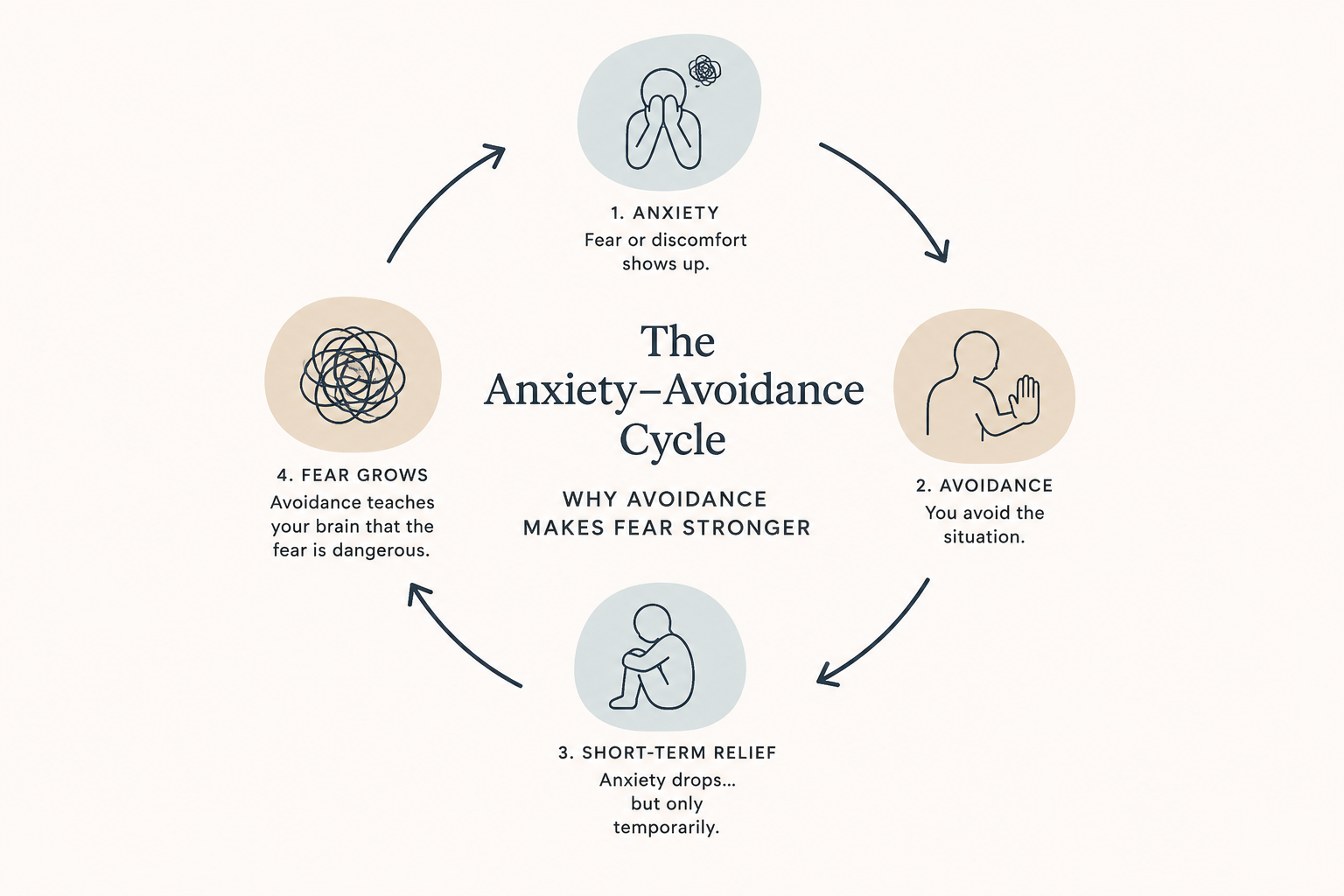
The anxiety–avoidance cycle can be summarized as:
Trigger → fearful thought → anxiety → physical symptoms → avoidance → temporary relief → stronger fear next time
Imagine someone who is afraid of speaking in public.
They think:
"I'm going to embarrass myself."
Their heart begins beating faster.
They become sweaty and tense.
They decide not to attend the presentation.
The anxiety drops.
The brain learns:
"Avoiding the presentation made me safe."
The next time a similar situation occurs, the fear may return even more strongly.
This doesn't mean the person is weak. Avoidance is a natural protective response. The problem occurs when avoidance becomes the primary way of managing ordinary situations.
The NHS explains that avoiding feared situations can provide short-term relief but may make fears harder to face over time.
Why Does Avoidance Feel So Effective?
The answer is immediate relief.
Imagine you're nervous about going somewhere alone.
You cancel the plan.
Within minutes, your anxiety decreases.
Your brain notices the change.
It doesn't necessarily understand that nothing dangerous happened. Instead, it may connect the dots like this:
I was afraid → I avoided the situation → I felt better.
That association can reinforce avoidance.
This is one reason anxiety can gradually become more restrictive.
Someone may initially avoid one specific situation.
Then another.
Then another.
Eventually, their world can become smaller without them realizing how it happened.
Anxiety Isn't Just in Your Head
One reason avoidance can become so powerful is that anxiety produces genuine physical sensations.
These can include:
These symptoms can feel frightening, particularly when someone doesn't understand why they're happening.
For example:
Heart beats faster → "Something is wrong." → fear increases → physical symptoms become stronger → escape feels necessary.
This can create a feedback loop.
The NIMH information on panic disorder describes how panic attacks can involve intense physical symptoms, including a racing or pounding heart, and how fear of these sensations can contribute to additional avoidance.
Avoidance Can Be Hidden
You don't always have to physically leave a situation to be avoiding anxiety.
Sometimes avoidance happens through what are called safety behaviors.
For example, someone might:
Constantly check their heartbeat
Search symptoms online for reassurance
Repeatedly ask friends whether everything is okay
Sit next to an exit
Avoid eye contact
Carry something they believe they cannot cope without
Leave events early
Distract themselves whenever anxiety appears
Avoid being alone
Rehearse conversations repeatedly
Check their body for signs of illness
These behaviors can provide reassurance in the moment.
However, they may also prevent a person from discovering that they can tolerate anxiety without constantly protecting themselves from it.
How Anxiety, Avoidance, and Medication Can Intersect
Medication can be an important part of treatment for some people with anxiety disorders, but medication and avoidance are not the same thing.
Several prescription medications are used in the treatment of certain anxiety-related conditions.
These include benzodiazepines such as Ativan (lorazepam), Xanax (alprazolam), clonazepam, and Valium (diazepam).
These medicines can reduce anxiety or produce calming effects, but they also have important safety considerations.
The FDA has issued a boxed-warning update concerning benzodiazepines because of risks including abuse, misuse, addiction, physical dependence, and withdrawal reactions.
This is particularly important because people sometimes assume that feeling calmer after taking a medication means they have permanently solved the underlying anxiety.
Medication may help manage symptoms, but treatment should be individualized.
A healthcare professional may consider medication alongside psychotherapy, lifestyle changes, behavioral approaches, or other interventions depending on the person's diagnosis and circumstances.
Never change the dose or suddenly stop a benzodiazepine such as lorazepam, alprazolam, clonazepam, or diazepam without medical guidance. Abrupt discontinuation after physical dependence has developed can cause potentially serious withdrawal symptoms.
Ativan (Lorazepam) and the Anxiety–Avoidance Cycle
Ativan, whose generic name is lorazepam, is a benzodiazepine medication that may be prescribed for certain anxiety disorders.
Because benzodiazepines can produce relatively rapid calming effects, some people may begin associating the medication with their ability to enter situations they fear.
That isn't necessarily a problem when medication is being used appropriately under medical supervision.
However, it is worth distinguishing between:
"This treatment is helping me manage my anxiety."
and:
"I absolutely cannot face this situation unless I take something first."
The second belief can potentially reinforce dependence on a safety behavior.
This is one reason treatment plans should be discussed with a qualified healthcare professional rather than adjusted independently.
Xanax and Fear of Anxiety Symptoms
Xanax (alprazolam) is another benzodiazepine used medically for certain anxiety and panic-related conditions.
Someone experiencing panic symptoms may become frightened not only of the original situation but also of the sensations themselves.
They might think:
"What if my heart starts racing?"
"What if I panic in public?"
"What if I can't get home?"
The fear of experiencing anxiety can then become a reason to avoid everyday activities.
This creates a particularly frustrating cycle:
Fear of anxiety → avoidance → temporary relief → increased sensitivity to anxiety → more avoidance.
Treatment aims to address the broader pattern rather than simply trying to eliminate every uncomfortable sensation immediately.
Clonazepam and Anxiety Management
Clonazepam is also a benzodiazepine and may be prescribed for certain seizure disorders and panic disorder.
Like other medications in this class, it can cause sedation and carries important risks involving misuse, dependence, and withdrawal.
People taking clonazepam should follow their prescriber's instructions carefully.
Medication decisions should also take into account other medicines and substances a person may be using because combining central nervous system depressants can increase risks.
Valium (Diazepam) and Anxiety
Valium, the brand name for diazepam, is another benzodiazepine medication.
It has several medical uses, including certain anxiety-related conditions, muscle spasms, and seizure disorders.
Like lorazepam, alprazolam, and clonazepam, diazepam can cause sedation and physical dependence.
The important lesson isn't that these medicines are "bad."
It's that they should be treated as prescription medicines requiring careful medical supervision, not as something to experiment with whenever anxiety appears.
Medication Isn't the Same as Exposure Therapy
This distinction is important.
Medication may reduce symptoms.
Exposure-based therapy focuses on changing your relationship with the feared situation.
For example, imagine someone who is afraid of elevators.
They might start with:
Looking at pictures of elevators.
Watching videos of elevators.
Standing near an elevator.
Entering an elevator with another person.
Riding one floor.
Gradually increasing the challenge.
The objective isn't necessarily:
"I must feel absolutely no anxiety."
Instead, the goal may be:
"I can experience anxiety and still cope."
Exposure therapy is an important component of CBT for several anxiety and fear-related conditions. The NIMH discusses exposure-based approaches for phobias and related disorders.
Why You Shouldn't Force Yourself Into Your Biggest Fear
Breaking avoidance doesn't mean throwing yourself into the most frightening situation possible.
That can sometimes be overwhelming.
A better approach may involve gradual, structured steps, particularly when working with a therapist.
For example, someone afraid of social situations might begin with:
Step 1: Say hello to a neighbor.
Step 2: Make a short phone call.
Step 3: Have coffee with one person.
Step 4: Attend a small gathering.
Step 5: Participate in a larger social event.
The exact progression depends on the individual.
The important idea is to create opportunities to learn:
"I can handle discomfort without automatically escaping."
How to Break the Anxiety–Avoidance Cycle
1. Identify What You're Avoiding
Write down the situations you regularly avoid.
Be specific.
Instead of writing "people," write:
"I avoid making phone calls."
Instead of:
"I avoid going outside."
write:
"I avoid shopping alone."
Specificity makes patterns easier to recognize.
2. Identify the Fear Behind the Avoidance
Ask yourself:
"What am I afraid will happen?"
Perhaps you're afraid of embarrassment.
Maybe you're afraid of having a panic attack.
Maybe you're afraid that people will judge you.
Or perhaps you're worried about losing control.
Identifying the prediction is important because anxiety often treats predictions as facts.
3. Notice the Immediate Relief
Ask:
"What happens to my anxiety after I avoid the situation?"
If the answer is "I immediately feel better," you've identified an important part of the cycle.
4. Challenge the Prediction
Ask:
"What evidence do I actually have that this outcome will happen?"
This doesn't mean telling yourself that nothing bad can ever happen.
It means distinguishing between possibility and probability.
5. Take a Manageable Step
Choose something uncomfortable but realistic.
You don't have to eliminate anxiety first.
6. Repeat the Experience
One successful attempt may not completely change your fear.
Repetition matters.
Over time, you may begin developing a new belief:
"I don't have to escape every time anxiety appears."
What If Anxiety Comes Back?
Anxiety returning doesn't mean you've failed.
Stress, illness, poor sleep, major life changes, and difficult experiences can temporarily increase anxiety even after someone has made significant progress.
Instead of thinking:
"I'm back at the beginning."
try:
"I've experienced this before, and I know some strategies that can help."
Progress isn't always a straight line.
When Should You Seek Professional Help?
Consider speaking with a healthcare or mental-health professional when anxiety:
Interferes with work or education
Disrupts relationships
Makes you avoid normal activities
Interferes with sleep
Causes frequent panic attacks
Keeps you from leaving home
Leads to increasing dependence on reassurance or safety behaviors
Makes everyday life feel increasingly restricted
Psychotherapy, including CBT, is an established treatment approach for many anxiety disorders. The NIMH psychotherapy guide provides an overview of how psychotherapy can help people identify and change unhelpful thoughts, emotions, and behaviors.
If prescription medication is being considered, a healthcare professional can determine whether it is appropriate and discuss potential benefits, risks, interactions, and alternatives.
Frequently Asked Questions
Can avoiding something make anxiety worse?
Yes. Avoidance can provide immediate relief, but repeatedly avoiding safe situations may prevent you from learning that you can cope with the situation or tolerate the anxiety it produces.
Is anxiety avoidance always bad?
No. Avoiding genuine danger is sensible. The concern is avoidance that becomes excessive and begins restricting normal activities because of fear.
Are Ativan, Xanax, clonazepam, and Valium the same medication?
No. They are different benzodiazepines with different active ingredients and pharmacological characteristics. Ativan contains lorazepam, Xanax contains alprazolam, and Valium contains diazepam, while clonazepam is the active ingredient in clonazepam products. They should not be treated as interchangeable medications.
Can benzodiazepines cause dependence?
Yes. Benzodiazepines can cause physical dependence, and the FDA warns about risks including misuse, addiction, and withdrawal. They should be used only according to medical advice.
Is exposure therapy the same as forcing yourself to face your fears?
No. Exposure therapy is generally structured and gradual. A mental-health professional can help determine an appropriate approach based on the individual's symptoms and circumstances.
Can anxiety cause a racing heartbeat?
Yes, anxiety and panic can produce noticeable cardiovascular sensations, including a rapid or pounding heartbeat. However, persistent, new, severe, or unexplained heart symptoms shouldn't automatically be attributed to anxiety. A healthcare professional can evaluate them appropriately.
Final Thoughts
The anxiety–avoidance cycle can make life progressively smaller.
You avoid something because you're afraid.
You feel relief.
Your brain learns that avoidance worked.
The next time the situation appears, the fear returns.
And the cycle begins again.
Breaking that cycle doesn't mean never feeling anxious.
It means gradually learning that anxiety is something you can experience without allowing it to make every decision for you.
Medications such as Ativan (lorazepam), Xanax (alprazolam), clonazepam, and Valium (diazepam) may have legitimate medical roles for certain conditions, but they require careful professional oversight because of their potential for sedation, dependence, misuse, and withdrawal.
For many people, long-term improvement involves more than simply reducing symptoms. It can involve understanding the fear, changing avoidance patterns, developing healthier coping strategies, and gradually returning to activities that anxiety has taken away.
You don't have to wait until you feel completely fearless.
Sometimes recovery begins with a much smaller thought:
"I'm anxious—but I don't have to run."